Platform Architecture
Management Plane, Runtime Clusters, GitOps delivery — how gh0stcloud is built.
gh0stcloud is split into two clearly separated layers: the Management Plane coordinates identity, secrets and billing, while Runtime Clusters run tenant workloads in isolation. The only permitted bridge between the two is GitOps.
Architecture principle: Desired state is written to Git, reconciled by Flux CD, and applied by the provisioning layer. Direct mutations to runtime objects are not a supported operational path.
Architecture overview
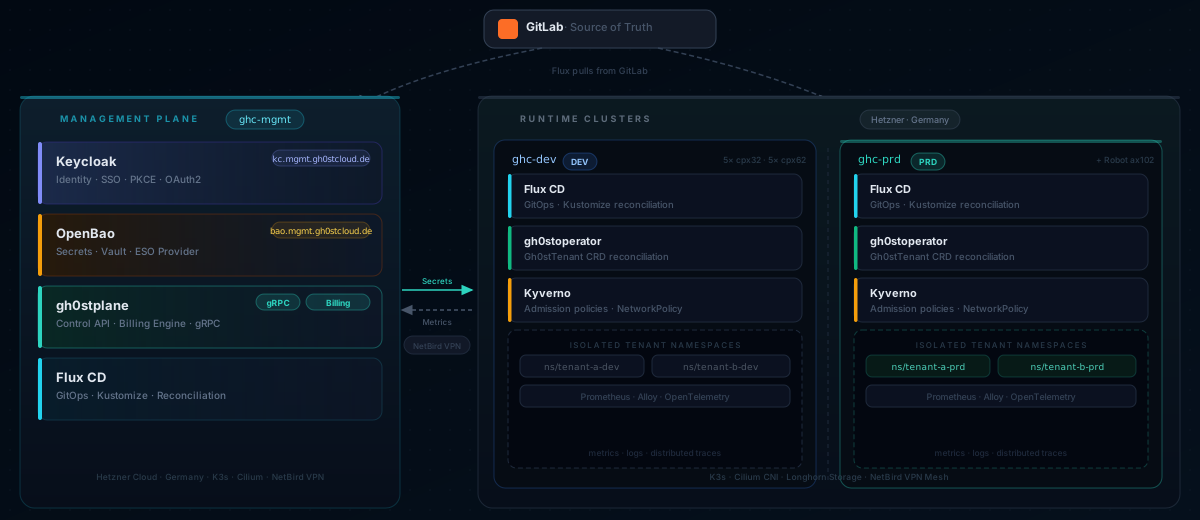
Cluster topology
| Environment | Role | Hardware | Location |
|---|---|---|---|
| Management Environment | Management Plane | dedicated bare-metal server | Germany |
| Development Environment | Development Runtime | shared compute nodes (control + worker) | Germany |
| Production Environment | Production Runtime | shared compute nodes + optional dedicated bare-metal server | Germany |
All clusters run K3s with Cilium as CNI and are connected to a private VPN mesh via NetBird.
Management Plane
The Management Plane hosts all platform services and carries no tenant workloads:
| Service | Function |
|---|---|
| Keycloak | Identity provider — SSO, OIDC, PKCE, OAuth2, tenant organisations |
| OpenBao | Secrets authority — credentials distributed to namespaces via ESO, never as plain-text |
| gh0stplane | Platform control API — billing aggregation and portal backend |
| Flux CD | GitOps reconciliation engine |
Keycloak manages tenant organisations as isolated identity boundaries. Each tenant gets a dedicated organisation with scoped groups and roles — no shared identity context across tenants.
OpenBao is the sole secrets authority. Workloads receive credentials exclusively through automatic synchronisation into their namespace — secrets are never stored in the repository or manually applied.
gh0stplane is the platform's business logic: billing aggregation from usage data, the portal API, and monthly invoice generation.
Runtime Clusters
Each runtime cluster runs the same service baseline:
| Service | Function |
|---|---|
| Flux CD | GitOps pull from the tenant source repository |
| Provisioning system | Reconciles platform configuration and tenant namespaces |
| Kyverno | Admission policies, NetworkPolicy baseline, namespace guardrails |
| Prometheus + Alloy | Metrics collection and log/trace forwarding |
| Beyla | eBPF-based automatic application instrumentation — no code changes required |
Each tenant gets at least one dedicated, isolated namespace. Network policies blocking cross-tenant traffic are applied automatically.
GitOps delivery — how changes flow
All changes follow a single, auditable path:
Source Repository
  └─► Flux CD
        └─► Provisioning layer
              └─► Namespace · RBAC · Policy · Workload
There is no click-ops path. Anyone who wants to change something in the cluster does it through a Git commit. The reconciliation order is strictly governed — from core services through to tenant workloads.
Network and connectivity
- Internal: NetBird VPN mesh connects all clusters. No public exposure for internal APIs.
- Tenant ingress: Via a controlled ingress controller per cluster, configurable per tenant.
- Egress: Dedicated egress node for production, to keep outbound IPs manageable.
Open-source foundation
gh0stcloud is built entirely on CNCF and open-source projects: Kubernetes, K3s, Cilium, Flux CD, Keycloak, OpenBao, Prometheus, Grafana, Kyverno. Proprietary knowledge lives in the operations and automation layer — not in lock-in components.
Questions or ready to get started?
Talk to us